|
Greetings Decision Maker,
Organizations today face a pivotal challenge: integrating transformative technologies like Generative AI (Gen AI) while maintaining the values, trust, and collaboration that define their culture. Gen AI is not just a tool for efficiency—it's a disruptor that reshapes how people work, communicate, and solve problems. However, without a corresponding cultural transformation, the full potential of Gen AI will remain out of reach.
Resetting the culture code is about more than adopting technology; it's about redefining how organizations collaborate, innovate, and align their actions with their core mission. This cultural reset ensures that employees and stakeholders see AI as an ally in achieving shared goals rather than a source of disruption or inequity.
To learn more, check out this blog.
|
|
|
|
|
|
|
Prefer video to text? See this video based on the blog: |
|
|
|
|
If you prefer audio, listen to this podcast based on the article: |
|
|
|
|
Make Your Voice Heard
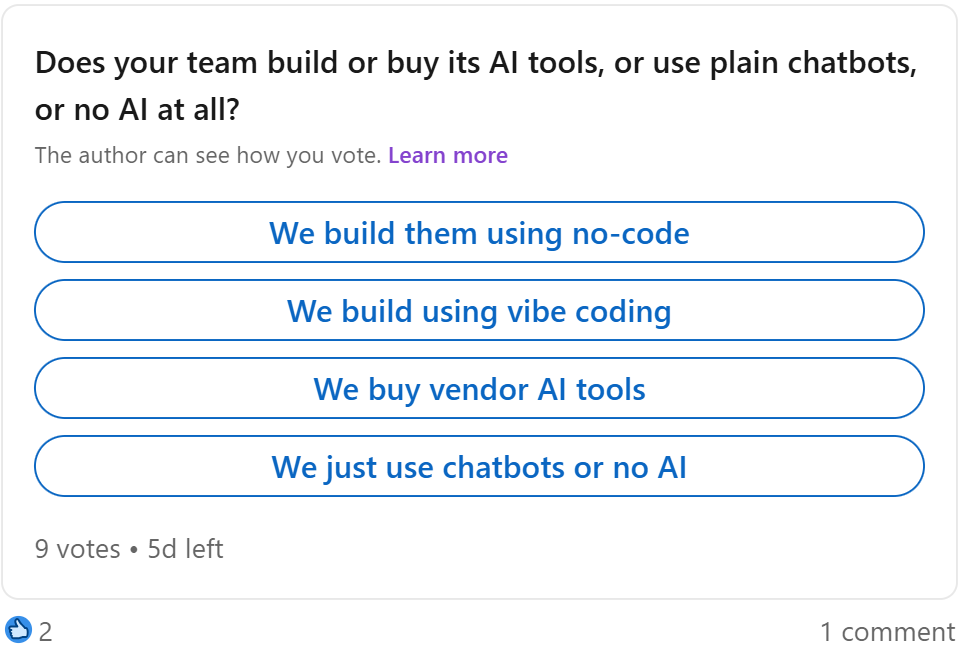
Vote in this LinkedIn poll to contribute to the conversation. I will use the responses to inform my articles in Harvard Business Review, Fortune, and Entrepreneur. |
|
|
|
|
Your Testimonials
You and others who gain value from Disaster Avoidance Experts consulting and speaking services and thought leadership occasionally share testimonials about your experience, such as the one below. You can read more testimonials here. |
|
|
|
|
"We contacted Gleb to acquire some insights in how to motivate scientific people to 'sell' themselves – a constant challenge of the business. Gleb used his researched-based approach to behavioral psychology to engage us in a conversation that provided several very helpful insights into how we communicate with our people. We were using far too much business-speak that was not connecting emotionally with our people. For example we have stopped using the word 'brand' and now use the word reputation – which resonates with scientists. So I have to say that one of the things Gleb said to me – I am not an engineer and have never been an engineer – but I work in human resources. And he started talking to me about emotions. My first response was: "engineers have emotions?" And he went on to teach me that engineers – scientists – although they like to think of themselves as rational animals, still are primarily driven like the rest of us by emotional thinking and emotional responses to language. Gleb has been an unexpected and practical resource for us."
- Mark Matson, Vice President of Human Resources at EWI |
|
|
|
|
What's Up With Me
|
|
I discovered a pretty unpleasant situation when I returned from my trip to Phoenix and San Diego recently. Namely, one of my employees really slacked off during this time and did her work at literally 25% capacity. She has a very clear task of lead generation, and there was nothing new about this task for her, she did it plenty of times in the past. But for some reason, she produced four times less output than the norm, whether for her in the past or for other team members doing such tasks. And it’s not like it was an office situation and the leader was gone, she works remotely, as does much of the rest of my team. Moreover, she must have known, at least on some level, that her very subpar work would be discovered and caught: while I’m not super detail-oriented and focus more on the big picture, I do pay attention. It was very frustrating. Since this was her first serious offence, I only penalized her for the time not worked, and didn’t impose an extra punitive penalty. I don’t understand why she would violate trust like that, knowing I was away and not focusing on the day-to-day work. Things like this push me into a more suspicious and anxious direction, and I have to be conscious to avoid falling into bad micromanagement tendencies; after all, the rest of the team members did well, and it would be bad for everyone involved if I micromanaged 6 people because one person screwed things up. Hopefully she learns her lesson. |
|
|
|
|
Would love to get your feedback on what you found most useful about this edition of the “Wise Decision Maker Guide” - simply reply to this email.
Decisively Yours,
Dr. Gleb
|
|
|
|
|
Dr. Gleb Tsipursky
CEO of Disaster Avoidance Experts
PS: Are we connected on LinkedIn? If not, please add me.
Did you miss out on reading any of my bestselling books? |
|
|
|
|
Disaster Avoidance Experts is a social enterprise dedicated to promoting science-based truth-seeking and wise decision-making. All profits are donated to Intentional Insights, an educational 501(c)(3) nonprofit organization, and its Pro-Truth Pledge project.
You're getting this email because you indicated that you wanted Dr. Gleb's resources. |
|
|
|
|